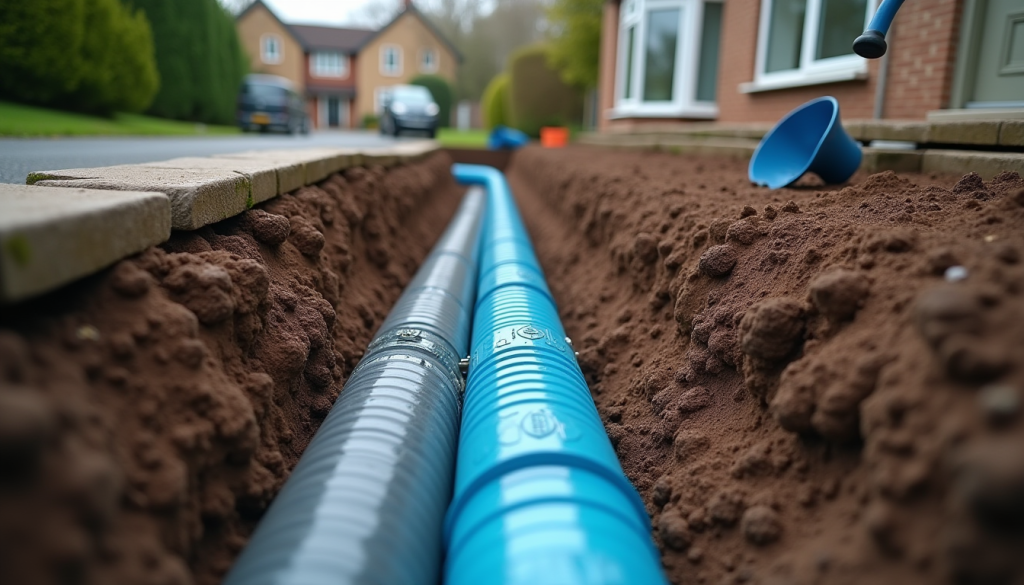
If you need to install a new pipe or duct without opening up a long trench, two methods tend to come up quite quickly: moling and directional drilling.
From the outside, they can sound fairly similar. Both are trenchless. Both can reduce disruption. Both may help you avoid digging up large sections of a driveway, path or garden.
Still, they are not the same thing, and choosing the wrong method can make a job harder, slower or more expensive than it needs to be.
In some cases, moling is the obvious answer. In others, directional drilling is likely to be the better fit. And now and then, neither is ideal and a more traditional excavation route makes more sense.
At a glance
| Method | Usually best for | Main limitation |
|---|---|---|
| Moling | Shorter, fairly straight runs under gardens, driveways and simple domestic routes | Less control over direction and depth |
| Directional drilling | Longer runs, more complex routes, obstacle crossings and jobs needing precise steering | More technical, and often more involved than a simple moling job |
What moling usually suits
Moling, or impact moling, uses a pneumatically driven tool known as a mole to create a bore underground between two small pits. It is a well-established trenchless method and is commonly used for installing water pipes, ducts and cables over relatively short distances.
In plain English, it is often the simpler option for a straightforward underground run.
Say you need to get a new water supply from the boundary to the house without cutting a trench across the whole front garden. If the route is short, reasonably direct and the ground is suitable, moling may be the neatest way to do it.
Typical examples might include:
- replacing a domestic water supply pipe from the boundary to the property
- installing a duct beneath a driveway
- getting a cable to a garden office without digging across the lawn
- laying pipework where access is tight but the route is fairly simple
For that kind of work, moling can be a very sensible option. It is often quicker to set up than directional drilling, and for the right ground conditions it may be the more cost-effective route too.
That said, simplicity is the key point. Moling is not really about fine steering. If the route needs to bend, avoid several existing services, or hit a precise line at a specific depth, it may start to become the wrong tool for the job.
If you want a fuller breakdown of the method itself, we cover that here: What is Moling? Trenchless Technology for Underground Pipes.
What directional drilling usually suits
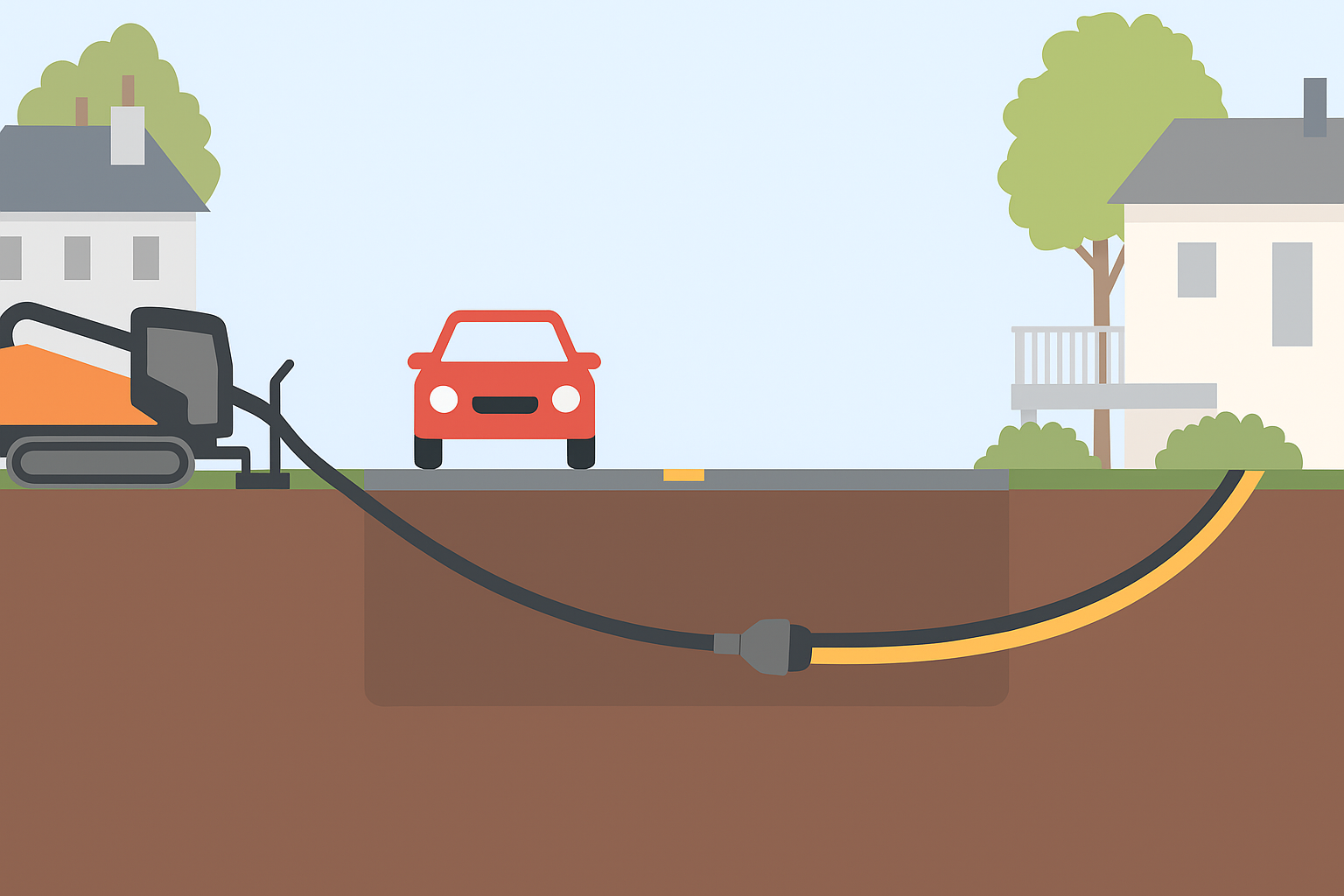
Directional drilling, often called horizontal directional drilling or HDD, is a more controlled trenchless method. Instead of simply driving a bore from one point to another, the drill path is guided along a planned route.
That extra control matters.
A directional drilling setup can be used where the route needs to pass beneath obstacles, hold a more precise line, or deal with a more demanding installation. It is often the stronger option where the bore needs to be steered rather than just driven in a fairly straight path.
Typical examples might include:
- crossing beneath a road, footpath or access route
- installing over a longer distance
- working around existing buried services
- needing better control over depth and line
- installing larger ducts or utility runs where accuracy matters more
A good example might be a utility route that needs to pass beneath a driveway, stay clear of existing services, and emerge in a very specific position. That is the sort of scenario where directional drilling may justify the extra complexity.
Our main service page gives a useful overview here: Directional Drilling.
The biggest difference is control
If there is one thing that really separates the two methods, it is probably control.
Moling is often effective for shorter, straighter runs, but it is not built for the same level of steering. Directional drilling is.
That does not automatically make directional drilling “better”. It just makes it better suited to jobs where precision matters more.
That distinction is worth making, because people sometimes hear “directional drilling” and assume it must be the premium option every time. Not really. On a simple domestic run, it may be more method than the job actually needs.
By the same token, moling can sound like the easy answer for everything trenchless. It is not. There are plenty of installs where more control is needed from the outset.
What about cost and disruption?
This is usually where the conversation gets more practical.
In broad terms, moling may be the cheaper option on a simple job. The equipment and setup are often more straightforward, and if the route is short and direct, it can be a very efficient way to get the work done.
Directional drilling is generally more technical. Because of that, it may cost more on some projects.
But cost is not just about the drilling method on its own. It is also about what happens around it.
If directional drilling avoids major reinstatement, helps preserve a driveway, reduces disruption, or makes a difficult route possible without opening everything up, the overall value may still be better.
So the real question is not always “which method is cheaper?” It is often “which method makes the most sense once the full job is considered?”
If you are weighing trenchless work against more traditional excavation, this related article is worth reading as well: Directional Drilling vs Open Trenching: When Each Makes Sense.
When a trench may still make more sense
This is the part people sometimes skip.
Not every job should be pushed into a trenchless method just because trenchless sounds cleaner. Ground conditions, access, route length, existing services and the nature of the install all matter.
There are cases where open excavation is still the more sensible route. If the ground is unsuitable, the route is exposed anyway, or the job needs direct access across the full run, traditional trenching may still be the practical choice.
That is one reason honest assessment matters at the start. A method should fit the site, not the other way round.
Which one is right for your job?
A fair answer would be: it depends on the route.
Moling is often the right fit where the job is:
- short
- fairly straight
- domestic in scale
- suited to a simple trenchless install
Directional drilling is more likely to be right where the job is:
- longer
- more complex
- constrained by obstacles
- dependent on precise line and depth control
If the aim is simply to avoid unnecessary disruption, either method may help. The difference is in how much control the job needs and how demanding the route actually is.
Need help deciding?
If you are planning a new utility run, replacing a water supply pipe, or trying to work out the least disruptive way to install pipework or ducting, it is usually worth getting the route looked at properly before deciding on a method.
At CW Pipewise, we carry out trenchless installations using methods that fit the site, the ground conditions and the type of service being installed. That may mean moling, directional drilling, or in some cases a different approach altogether.
You can also read more about:
If you are not sure whether moling or directional drilling is the better option, contact CW Pipewise and we can advise based on the route and the job itself.